

IPO Process


Understanding the IPO Process in India
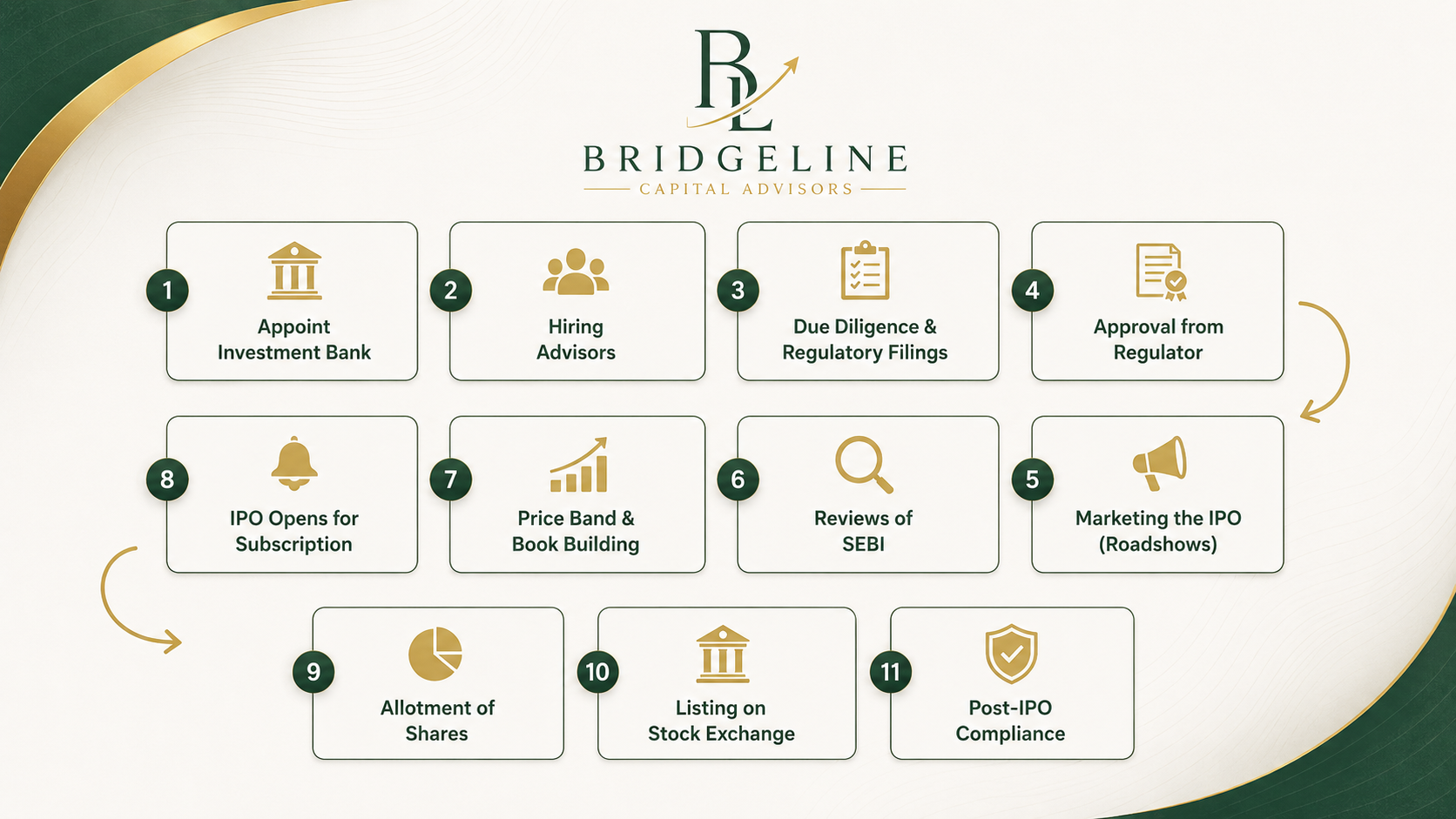
An Initial Public Offering (IPO) is the process through which a privately held company offers its shares to the public for the first time and becomes a publicly listed entity. The IPO journey involves multiple regulatory, financial, and legal steps designed to ensure transparency, investor protection, and compliance with market regulations. From appointing experienced advisors to completing regulatory approvals, marketing the issue, determining the share price, and finally listing on the stock exchange, every stage plays a vital role in a successful public offering. A well-executed IPO enables businesses to raise growth capital, enhance market credibility, increase brand visibility, and create long-term value for shareholders while providing investors an opportunity to participate in the company's future growth.
1

Appoint Investment Bank
The IPO journey begins with selecting a qualified investment bank, also known as the Book Running Lead Manager (BRLM). The investment bank acts as the primary advisor, helping the company plan the IPO strategy, determine valuation, prepare documentation, coordinate with regulators, and manage the entire public offering process. Their expertise ensures compliance with regulatory requirements while maximizing investor confidence and market participation. Choosing the right investment banking partner is one of the most critical decisions for a successful IPO.
2

Hiring Advisors
In addition to the investment bank, the company appoints experienced legal advisors, auditors, registrars, compliance experts, tax consultants, and public relations agencies. Each advisor plays a specialized role in ensuring legal compliance, financial accuracy, operational readiness, and effective communication with investors. Together, they help prepare all necessary documentation, manage regulatory obligations, and reduce potential risks throughout the IPO process. A strong advisory team improves efficiency and increases the likelihood of a successful public issue.
3

Due Diligence & Regulatory Filings
Comprehensive due diligence is conducted to evaluate the company's financial position, legal structure, operational performance, business risks, and corporate governance practices. Based on these findings, the Draft Red Herring Prospectus (DRHP) is prepared, containing detailed disclosures required by regulators. This document provides investors with transparent information about the company's business model, financial statements, risk factors, management, and intended use of IPO proceeds, ensuring informed investment decisions.
4

Approval from Regulator
After filing the Draft Red Herring Prospectus, regulatory authorities carefully review the company's disclosures and compliance with applicable laws. Regulators may seek clarifications, additional information, or modifications before granting approval. Once all observations are satisfactorily addressed, the company receives clearance to proceed with the public offering. Regulatory approval enhances investor confidence by ensuring that the IPO meets established legal and disclosure standards before reaching the market.
5

Marketing the IPO (Roadshows)
Before the IPO opens for subscription, the company actively promotes the offering through investor roadshows, presentations, media interactions, and meetings with institutional investors. Senior management explains the company's business model, financial performance, competitive strengths, and future growth strategy. These marketing initiatives help generate investor awareness, assess market demand, build credibility, and attract both institutional and retail investors, ultimately contributing to a successful subscription.
6

Reviews of SEBI
The Securities and Exchange Board of India (SEBI) reviews the Draft Red Herring Prospectus to ensure that all mandatory disclosures, financial information, risk factors, and corporate governance practices comply with regulatory standards. SEBI's review focuses on transparency and investor protection rather than approving the company's commercial viability. After the company satisfactorily addresses all regulatory observations, SEBI allows the IPO process to move forward.
7

Price Band & Book Building
The company, together with its investment bankers, determines a suitable price band based on financial performance, industry comparisons, market conditions, and investor demand. During the book-building process, institutional and retail investors submit bids within the specified price range. Based on subscription levels and market response, the final issue price is determined, ensuring fair pricing while balancing investor interest and the company's fundraising objectives.
8

IPO Opens for Subscription
Once regulatory approvals and pricing are finalized, the IPO opens for public subscription for a predetermined period. Investors can apply through banks, brokers, online trading platforms, or UPI-enabled applications under different investor categories such as Retail, Qualified Institutional Buyers (QIBs), Non-Institutional Investors (NIIs), and Employees. After the subscription period closes, applications are evaluated based on demand and applicable allotment guidelines.
9

Allotment of Shares
Following the closure of the IPO, the registrar processes all applications and allocates shares according to regulatory guidelines and subscription levels. In oversubscribed issues, shares may be allotted through a lottery or proportionate allocation system. Successful applicants receive shares in their demat accounts, while refunds or fund unblocking are processed promptly for unsuccessful or partially allotted applicants, ensuring a transparent allocation process.
10

Listing on Stock Exchange
After share allotment is completed, the company's equity shares are officially listed on recognized stock exchanges such as NSE and BSE. Trading begins on the scheduled listing date, allowing investors to buy and sell shares freely in the secondary market. The listing marks the company's transition from a private enterprise to a publicly traded company, improving liquidity, market visibility, and access to future capital.
11

Post-IPO Compliance
After listing, the company must comply with continuous regulatory and stock exchange requirements. These include timely financial reporting, corporate governance standards, disclosure of material events, shareholder communications, annual general meetings, and adherence to SEBI's Listing Obligations and Disclosure Requirements (LODR). Maintaining strong compliance enhances investor trust, protects shareholder interests, and supports the company's long-term reputation in the capital markets.
FAQ's
Frequently Asked Questions
An Initial Public Offering (IPO) is the process through which a private company offers its shares to the public for the first time and gets listed on a stock exchange to raise capital for business growth and expansion.
The IPO process typically takes 4 to 6 months, depending on the company's preparedness, regulatory approvals, due diligence, documentation, and prevailing market conditions.
The most important document is the Draft Red Herring Prospectus (DRHP), which includes the company's financial statements, business details, risk factors, management information, legal disclosures, and objectives of the issue.
After the subscription period ends, applications are verified, shares are allotted to successful applicants, refunds or fund unblocking are processed for unsuccessful bids, and the company's shares are listed on the stock exchange for public trading.
Bridgeline Capital Advisors provides end-to-end IPO advisory services, including transaction planning, due diligence coordination, regulatory support, documentation assistance, strategic guidance, and liaison with investment bankers and other professionals to ensure a smooth and compliant listing process.
Retail investors, Qualified Institutional Buyers (QIBs), Non-Institutional Investors (NIIs), employees, and eligible shareholders can invest in an IPO, subject to the applicable eligibility criteria and category-specific regulations.
Going public enables a company to raise capital for expansion, improve brand credibility, enhance market visibility, provide liquidity to existing shareholders, attract top talent through stock-based incentives, and access future fundraising opportunities.
Bridgeline Capital Advisors offers strategic IPO advisory backed by industry expertise, regulatory knowledge, and a client-centric approach. We guide businesses through every stage of the IPO journey—from planning and documentation to regulatory coordination and successful listing—ensuring a seamless and compliant process.
Start Your Journey with Us Today
Taking your company public is one of the most significant milestones in its growth journey, and having the right advisory partner can make all the difference. At Bridgeline Capital Advisors, we provide comprehensive IPO advisory services tailored to your business objectives, ensuring a structured, transparent, and efficient path to the capital markets. From evaluating your IPO readiness and coordinating due diligence to managing regulatory filings, liaising with investment bankers, and supporting your listing, our experienced team is committed to guiding you through every stage of the process.
We understand that every business is unique, which is why we offer customized strategies designed to maximize value while ensuring full regulatory compliance. Our focus is not only on helping you raise capital but also on strengthening your corporate governance, enhancing investor confidence, and positioning your company for sustainable long-term growth.